
_PNG.png)


INDUSTRIAL EQUIPMENT SHRINK WRAPPING IN BOISE, ID
Shrink Mobile provides industrial equipment shrink wrapping in Boise, ID, for cooling towers, chillers, air handling units, and other high-value assets that sit outdoors between delivery and installation. Semiconductor and industrial projects across the Treasure Valley move large equipment into staging yards well before a building, foundation, or utility tie-in is ready. That gap can last weeks or months, and every week outdoors exposes the equipment to weather, dust, debris, and pests.
Our mobile crews come to your yard or jobsite, wrap equipment after it is received, and help keep it protected until it is released for installation. Every wrap follows OEM preservation requirements and your approved site plan.
INDUSTRIAL SHRINK WRAP PROTECTION - OLATHE TO BOISE
Cooling Tower Shrink Wrapping for Boise Projects
Central utility plants depend on cooling towers, and those towers are usually delivered as multi-cell units or modular frames that are installed in sequence. When the equipment arrives before the building or foundation is ready, it waits in a laydown yard. At that point, protection is a schedule and cost issue as much as a weather one, because damage found at installation can delay the whole sequence.
When a project brings in many similar modules, we plan a consistent wrap layout, access points, and inspection routine so every unit gets the same level of protection. That keeps the work predictable for the crew and the general contractor.


RECEIVING YARD AND DESTINATION PROTECTION
Protection at the destination follows a simple sequence, so nothing is wrapped before it has been checked.

RECEIVE.
Equipment arrives on site, and the delivery is documented.

INSPECT.
The condition on arrival is recorded, and exposed openings are checked.

STAGE.
Units are positioned on supports in the storage area.

PROTECT.
Shrink wrap is applied after receipt, following OEM preservation requirements.

RELEASE.
Protection is removed when the unit is ready for installation.
The recording condition at receipt gives everyone a clear starting point if a question comes up later.
WINTER STAGING AND OUTDOOR EQUIPMENT STORAGE IN BOISE
Equipment left in a Boise yard deals with snow and ice in winter, freeze-thaw cycles, dry and windy conditions that lift dust, and rain in shoulder seasons. On an active construction site there is also loose rock and debris near traffic. Where openings are left exposed, animals and insects move in. For most projects, winter staging is the longest and most damaging exposure period, which is why we plan the wrap around how long the equipment will actually sit.

01
RAIN AND MOISTURE:
Equipment arrives on site, and the delivery is documented.
02
INSPECT.
The condition on arrival is recorded, and exposed openings are checked.
03
STAGE.
Units are positioned on supports in the storage area.
04
PROTECT.
Shrink wrap is applied after receipt, following OEM preservation requirements.
05
RELEASE.
Protection is removed when the unit is ready for installation.
Actual yard layout, access lanes, and protection details depend on the project site plan and OEM review.
PROTECTION THROUGH INSTALLATION AND WRAP REMOVAL
Delivered does not mean installed. Equipment often moves from the storage yard to its final position weeks or months after arrival, and that final move is where wrap and equipment are most likely to be damaged.
COOLING TOWER PROTECTION THROUGH INSTALLATION—BOISE, IDAHO
01
During storage: wraps, supports, and openings are inspected. Wind damage, trapped moisture, and pest entry are the main things to watch for.
02
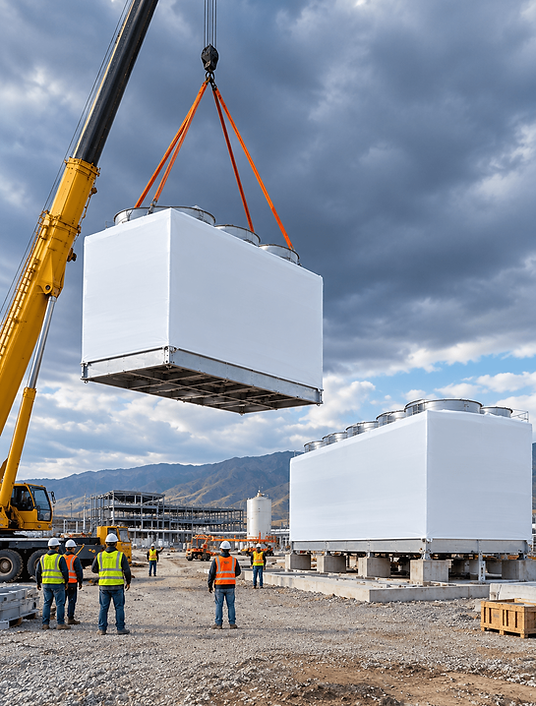
During the final lift: use approved lift points and coordinate with the qualified rigging team. Handling impact, sling abrasion, and wrap tears are the risks to plan around.
03
At installation release: remove protection in sequence as installation becomes ready. Removing it too early exposes equipment to rain and construction dust.
Preserve staged equipment through final handling and remove protection in sequence with installation.
FROM OLATHE TO BOISE: PROTECTION AT BOTH ENDS
Much of the industrial cooling equipment used on large projects is built at OEM plants such as SPX Cooling Technologies' facility in Olathe, Kansas, and shipped to project sites by road. The Olathe to Boise route is roughly 1,387 road miles, and transit typically takes several days, depending on load size, permits, and weather. These are planning estimates, not a carrier itinerary. Planning protection at the factory and at the destination gives the equipment a consistent standard across the whole trip.
Read the factory side of the journey: Industrial equipment shrink wrapping in Olathe, KS →
MARKET LOGISTICS INSIGHTS: BOISE, ID
Cooling Tower Shrink Wrapping—Boise, Idaho
Micron is building its first Boise memory fab, announced in 2022 as a $15 billion investment, with first DRAM output projected for mid-2027. A second Idaho fab is planned, with initial output expected in late 2028. Projects at this scale move large volumes of cooling towers, chillers, and utility equipment through staging yards over several years, which is where weather and installation delays create protection risk.
HOW TO GET A PROPOSAL FOR YOUR BOISE PROJECT
1
Submit your project. Tell us about your equipment and site.
2
Receive a proposal. Shrink Mobile advertises a 24-hour proposal turnaround.
3
Mobilize. Our team deploys to your location.
4
Project protected. Equipment is wrapped, inspected, and kept protected until release.
TO SCOPE THE WORK ACCURATELY, SEND:

Company and contact details
Equipment location (Boise or nearby)
Asset type and quantity
Dimensions and weight
Timing and expected storage duration
Drawings or photos
Site access constraints and staging conditions
Film requirements, such as fire-retardant rating or mil thickness
FREQUENTLY ASKED QUESTIONS
- 01
- 02
- 03
- 04
- 05
- 06
- 07